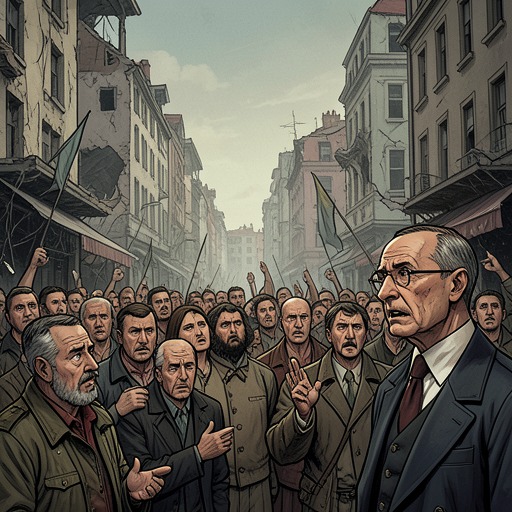
Plinius Ziegenhalss
The Glass Bead GamePlinius Ziegenhalss is the historian through whose work the novel reconstructs the Age of the Feuilleton, a formative but poorly understood era, and traces the Glass Bead Game’s development from a musical pastime into a demanding intellectual practice. His account is both a source of historical detail and a caution against judging the past too confidently: the culture that preceded Castalia was not simply ignorant, but struggled to place knowledge within the life of society.
Identity and Historical Importance
Ziegenhalss is identified as a historian of literature and, in the narrator’s account, the sole serious investigator of the Feuilletonistic Age. The intellectual movement that eventually produced both the Order and the Glass Bead Game is traced back to this period. Though the age is separated from the narrator’s present by a great historical distance, its soil nourished much of contemporary cultural life.
The label “Age of the Feuilleton,” which Ziegenhalss gave the era, is useful but potentially distorting. The narrator warns that such labels can encourage a slanted view, and emphasizes that the period was neither uncultured nor intellectually impoverished. Its deeper failure, as Ziegenhalss describes it, was not knowing what to do with culture or how to assign it a proper place in the life of the nation. The account therefore makes him a guide to a historical problem, not merely a collector of colorful period details.
Ziegenhalss’s Account of Intellectual Freedom
In Ziegenhalss’s historical picture, European intellectual life since the end of the Middle Ages had followed two partly conflicting lines. One was the liberation of thought and belief from authority: Reason’s struggle to free itself from the Roman Church. The other was a covert but passionate search for a new authority, grounded in Reason itself, that could make this freedom legitimate. The movement won intellectual independence, but did not resolve the tension between freedom from authority and the need for a binding source of legitimacy.
The narrator presents Ziegenhalss’s account of the Age of the Feuilleton as a consequence of that unresolved struggle. Intellectual freedom had become extraordinarily extensive, after the tutelage of the Church had been overthrown and that of the State partly weakened, but no authentic new law or authority had taken its place. Ziegenhalss’s examples of intellectual debasement, venality, and self-betrayal give this absence a cultural form. The narrator refuses to turn history into a judgment about whether its victims’ suffering was worthwhile; the struggles and their consequences happened, and their meaning cannot simply be settled by wishing them otherwise.
The Feuilleton and Its Readers
Ziegenhalss documents the feuilleton through a wide range of literary and other sources. These pieces appeared in a popular section of daily newspapers, were produced in enormous quantities, and supplied mental fare to readers seeking culture. They ranged over a thousand subjects, more often chatting about knowledge than presenting it with disciplined seriousness. Their writers included newspaper staff and freelance contributors; many were classified as writers, while others came from scholarly circles, including university professors.
The recurring subjects show the peculiar mixture of learning and trivia. Articles took anecdotes from the lives and correspondence of famous people, with titles such as “Friedrich Nietzsche and Women’s Fashions of 1870” and “The Composer Rossini’s Favorite Dishes.” Other pieces supplied historical background for topics fashionable among the well-to-do, including the centuries-long dream of creating gold and experiments in influencing the weather. Some articles were so incomprehensible that Ziegenhalss considered them possible acts of self-mockery by their authors. The narrator leaves open whether the feuilletons’ irony can still be recognized without recovering their lost key, preserving an uncertainty within the historian’s reconstruction.
Ziegenhalss’s documentation also sharpens the period’s central contradiction: authors of repute and sound education helped serve a mass appetite for this manufactured miscellany. The problem was not simply that readers consumed trivial material, but that intellectual ability and cultural prestige were enlisted in supplying it. His account makes the feuilleton a symptom of a society unable to give its freedom of knowledge a coherent purpose.
From Musical Plaything to Intellectual Method
Ziegenhalss’s history reaches beyond the newspaper culture of his chosen period. In tracing the Glass Bead Game’s development, the narrator draws on his description of a later cultural consciousness that had survived crisis and, in Ziegenhalss’s formulation, accepted with modest pride that it belonged to a culture past its prime, like Hellenistic culture in the Alexandrian Age. This comparison frames the Game’s history as part of a broader reflection on how cultures inherit, transform, and understand their own intellectual achievements.
The Game began as a musical exercise using a frame modeled on a child’s abacus. Its wires corresponded to lines of musical notation, and beads of different sizes, shapes, and colors represented musical values; players could set out quotations or invented themes, transpose and develop them, and place them in counterpoint. After the game lost popularity among music students, mathematicians took it up. Under their use it became more flexible and abstract, capable of representing mathematical processes through special symbols and abbreviations. The history illustrates the Game’s repeated passage to whichever branch of learning was undergoing a period of growth or renewal.
Ziegenhalss’s importance lies in the scale of the connection his scholarship makes possible. The feuilleton’s mass production of fragments of knowledge and the Glass Bead Game’s later elaboration of relationships among disciplines are not presented as unrelated curiosities. Together, they mark a long effort to determine what culture is for and how knowledge might be ordered. His historical account gives the Game a past while showing why intellectual freedom alone could not supply the authority, purpose, or integration that this later institution sought.